
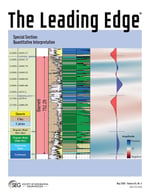
 A summary of Ikon Science’s published article in The Leading Edge, “Integrating machine learning with rock physics for multizone property prediction,” featured in the May 2026 Special Section: Quantitative Interpretation.
Turning Incomplete Well Data into Physically Consistent Reservoir Predictions
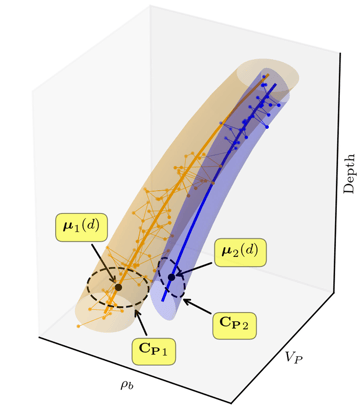
Predicting reliable elastic and petrophysical properties across complex reservoirs is one of the most persistent challenges in quantitative interpretation. In fields with multiple stacked pay zones, variable depositional environments, and limited core or laboratory measurements, subsurface teams often need to calibrate separate rock physics models for different rock types before they can confidently predict missing logs, classify facies, or build inputs for seismic inversion.
Machine learning can accelerate parts of this process, but purely statistical models may not always honor geologic context or physical relationships. When machine learning is not guided by rock physics, models can generate nonphysical logs, unrealistic facies transitions, or depth trends that conflict with stratigraphy.
That is where Rock Physics Machine Learning, or RPML, adds value.
In the article, Ikon Science’s Paritosh Bhatnagar and Anastasya Teitel present a rock physics-guided machine learning workflow that integrates statistical learning with physically constrained rock physics models. The workflow predicts facies, elastic properties, and petrophysical properties across multiple wells simultaneously, while keeping results within physically realistic bounds.
Ikon Science authors Paritosh Bhatnagar and Anastasya Teitel were featured in the May 2026 issue of The Leading Edge, Special Section: Quantitative Interpretation.
Why Physics-Constrained Machine Learning Matters
In subsurface interpretation, predictions are only useful if they remain geologically and physically plausible. Standard machine learning approaches can identify statistical patterns in data, but those patterns may not transfer well when geology changes from one field, basin, or stratigraphic interval to another. As new wells come online or geologic understanding improves, models may require retraining or recalibration.
RPML helps address this limitation by using rock physics principles to guide machine learning models. The approach incorporates domain knowledge such as impedance contrast, elastic moduli, porosity transforms, and rock physics-based facies templates to improve discrimination between facies and petrophysical properties.
Instead of relying on data patterns alone, RPML ties predictions back to the expected relationships between porosity, saturation, mineralogy, compaction, elastic response, and facies. This gives interpretation teams a stronger foundation for log prediction, facies classification, and reservoir characterization in data-scarce settings.
Parameterized rock physics models help constrain predictions so outputs remain consistent with measured well data and expected rock behaviour.
How RPML Works
RPML is a physics-constrained statistical learning workflow that combines rock physics models with probabilistic modelling. Each facies is associated with a selected rock physics model (carbonates, sandstone, shales), and an expectation-maximization optimization procedure is used to estimate facies probabilities and update model parameters in a multi-well setting.
The workflow uses common well-log inputs such as gamma ray, density, neutron porosity, resistivity, and elastic logs where available. From these inputs, RPML calibrates rock physics models for multiple facies and optimizes the model parameter needed for successful RPM calibration.
Once configured, RPML produces refined log predictions, facies classifications, calibrated rock physics models, and posterior facies distributions across rock types. These outputs provide a practical starting point for building rock physics templates that can be refined and shared across technical teams.
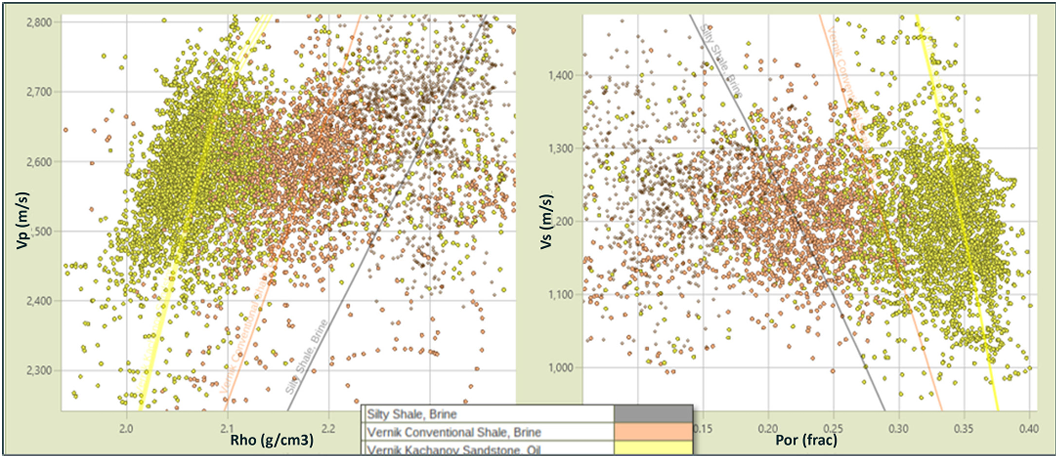
The workflow also supports quality control by validating facies separation across rock physics, petrophysical, and elastic domains, helping teams assess whether predicted facies remain consistent across different measurements and interpretation spaces.
Multiwell crossplots help validate RPML facies predictions across rock physics, petrophysical, and elastic domains, supporting more consistent interpretation across wells.
Tested Across Two Geologically Distinct Settings
The workflow was tested in two different geologic settings: the Athabasca Oil Sands in northeastern Alberta and the Barnett interval of the Midland Basin. These examples demonstrate how RPML can support property prediction and reservoir characterization across both sandstone-dominated and shale-dominated systems.
In the Athabasca example, the workflow classified three main facies: oil sands, shaly sand, and shale. These distinctions are important because reservoir-quality sands, transitional intervals, and sealing units can influence fluid movement and recovery strategies.
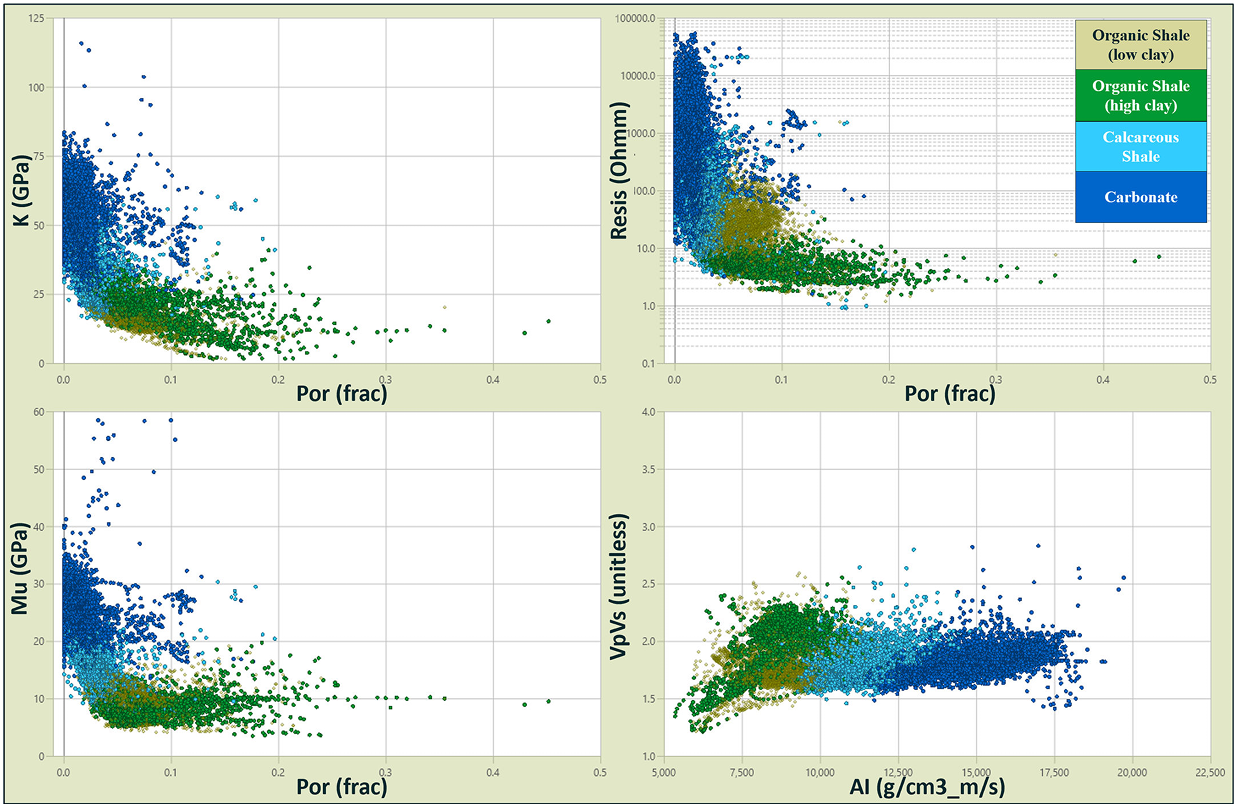
In the Midland Basin example, RPML was applied within the Barnett interval to help characterize clay content and identify facies that may be important for drilling, completion, and fracture stimulation decisions. The study classified low- and high-clay organic-rich shales, calcareous shales, and carbonates.
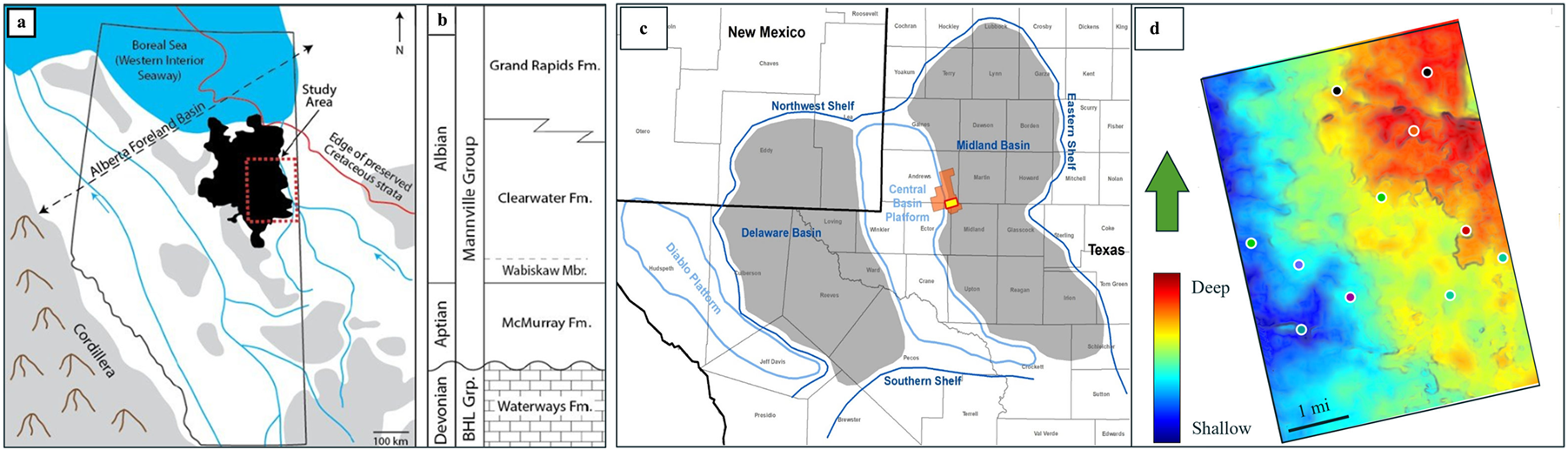
The RPML workflow was tested in the Athabasca Oil Sands and Midland Basin to evaluate performance across different geologic settings.
Outcome 1: More Consistent Facies Classification
One of the core outcomes demonstrated in the article is the ability to classify facies across multiple wells while maintaining geologic consistency. In the Athabasca example, RPML helped distinguish potential bitumen-bearing channel sands from transitional and sealing intervals at the log scale. The workflow also generated facies likelihood curves, which provide context for uncertainty and help identify mixed or transitional lithologies.
This is important because subtle facies changes can influence reservoir connectivity, fluid flow, and development planning. By combining facies probabilities with rock physics constraints, RPML provides more than a single deterministic classification. It gives teams a more complete view of facies likelihood and uncertainty.
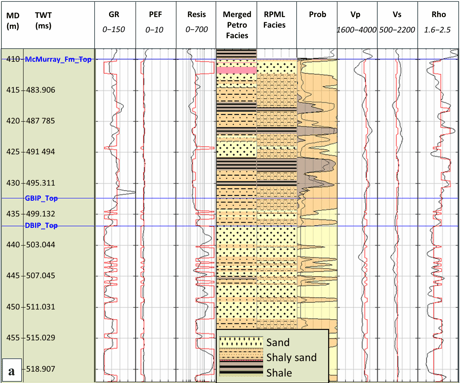
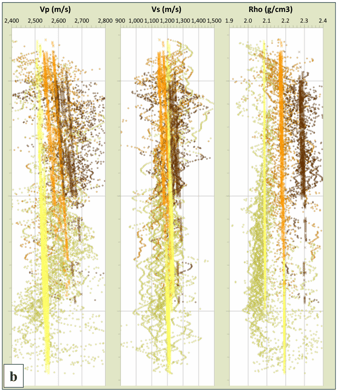
RPML compares measured and modelled logs while generating facies interpretations and depth trends for oil sands, shaly sands, and shale.
Outcome 2: Log Prediction and Repair
Reliable reservoir characterization often depends on having complete and consistent log suites. In practice, wells may have missing logs, tool-related errors, processing issues, or intervals where measurements are unreliable. The article shows how RPML can help reconstruct missing or spurious log data while maintaining rock physics-consistent trends.
In the Midland Basin example, RPML corrected a tool anomaly and predicted properties within rock physics constraints. The close agreement between measured and predicted curves demonstrated the workflow’s ability to reconstruct problematic logs without departing from expected physical relationships.
For subsurface teams, this provides a valuable path to improve interpretation readiness when working with incomplete or inconsistent well data.
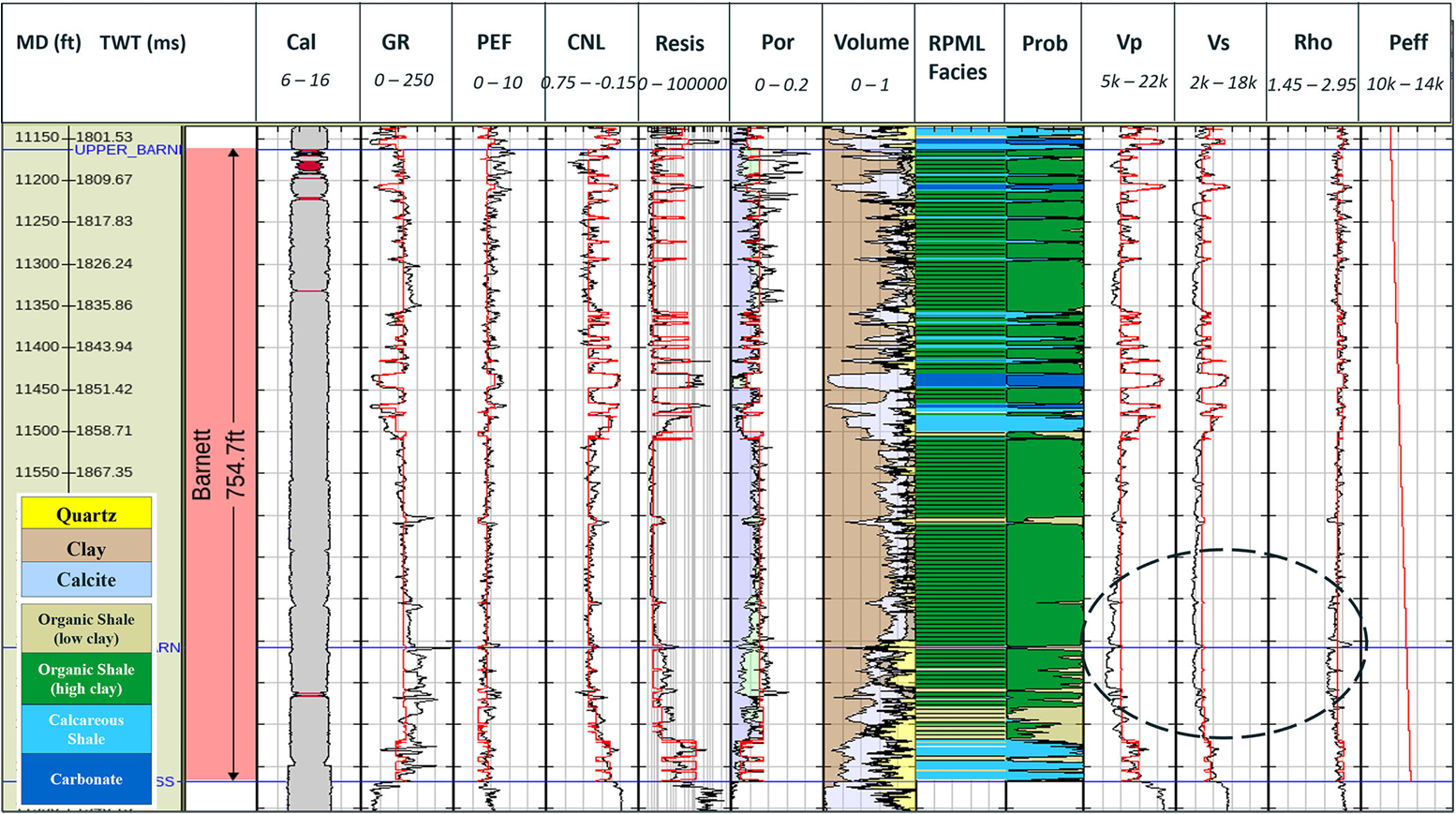
RPML predictions are compared with measured log data across the Barnett interval, supporting log repair, facies classification, and property prediction.
Outcome 3: Blind-Well Prediction from Limited Inputs
To test the robustness of the workflow, the RPML model was applied to a blind well where only triple-combo logs were available. The workflow predicted VP, VS, porosity, PEF, effective pressure, and facies classification, allowing interpreters to estimate key properties in a data-scarce setting.
This demonstrates how RPML can help teams extend quantitative interpretation workflows into wells with limited log availability.
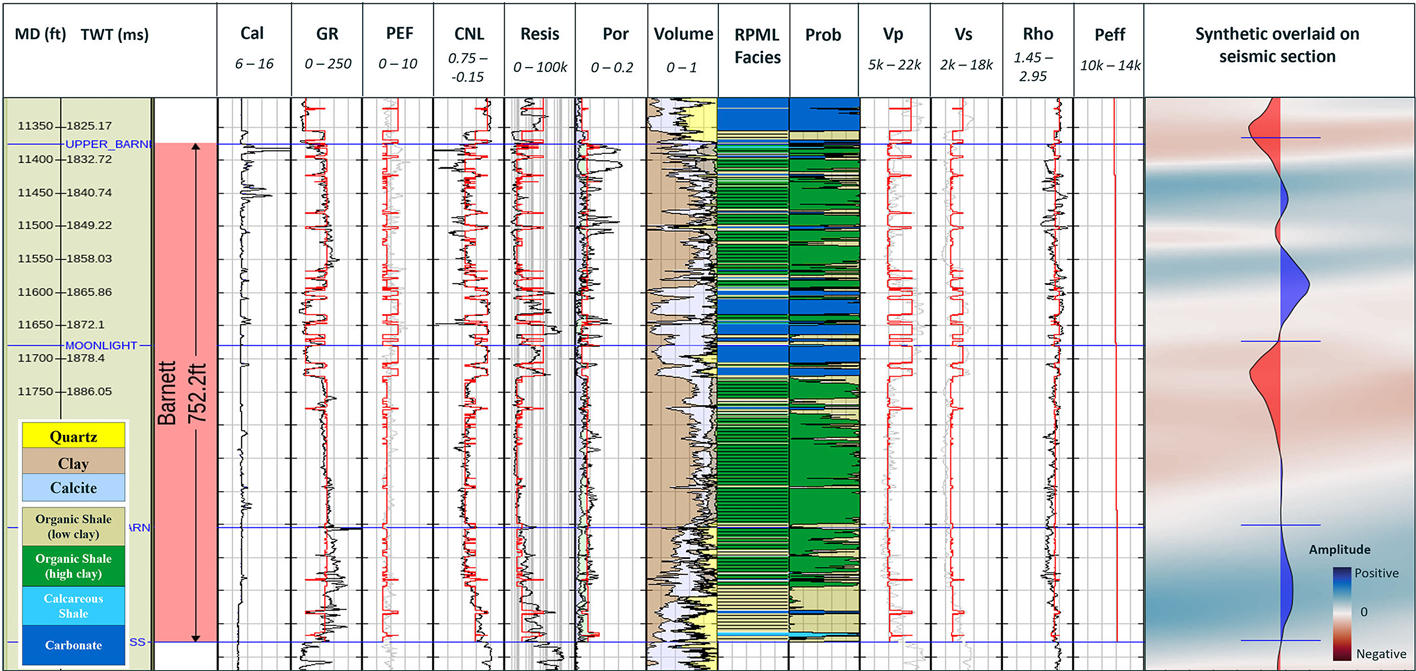
In a blind-well test, RPML predicted key properties from limited log inputs and supported well-to-seismic tie comparison.
Outcome 4: Better Inputs for Reservoir Characterization and Inversion
Beyond log prediction and facies classification, RPML supports broader quantitative interpretation workflows. The article notes that posterior facies distributions can be used as prior information for facies-based inversion and refined further for predicting facies in 3D using seismic data. Additional use cases include building low-frequency models for seismic inversion and applying depth-varying Bayesian classification methods to improve facies prediction.
This makes RPML especially valuable for teams that need to connect well-based interpretation to seismic-scale reservoir characterization.
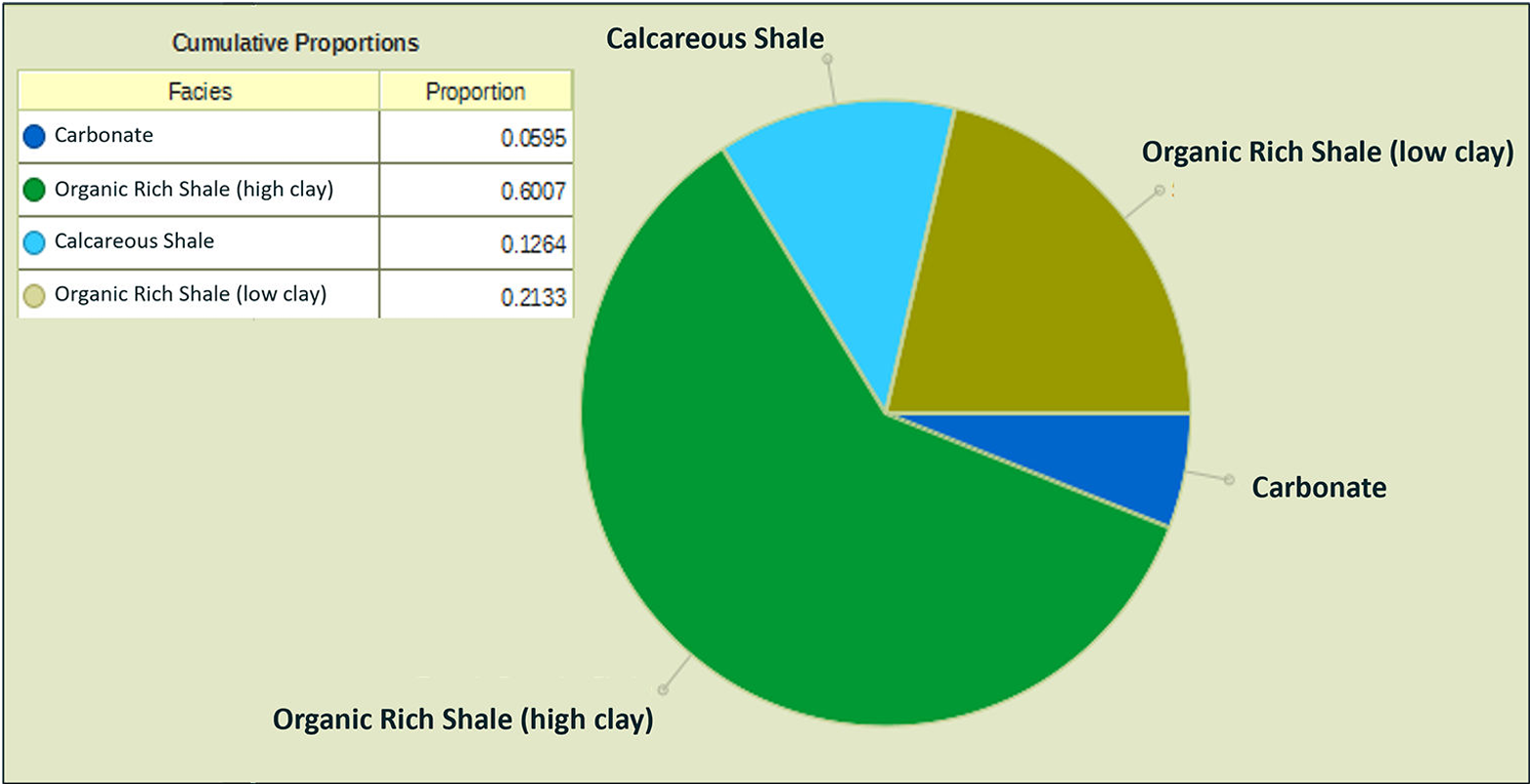
Posterior facies proportions from RPML can support facies-based inversion and broader reservoir characterization workflows.
What This Means for Subsurface Teams
The article demonstrates that rock physics-guided machine learning can help teams work more efficiently while improving confidence in property prediction. By combining statistical learning with physically constrained rock physics models, RPML reduces manual calibration effort and provides consistent predictions of elastic and petrophysical properties across multiple zones and facies.
For geoscientists, petrophysicists, and quantitative interpretation teams, this means:
- More reliable property prediction from limited well data
- Faster rock physics template calibration
- Better facies classification across multiple wells
- Improved log repair and reconstruction
- Stronger inputs for well-to-seismic ties and seismic inversion
- A more scalable workflow for complex multizone reservoirs
RPML helps move machine learning beyond pattern recognition by anchoring predictions in the physics of the rock. For teams working in complex reservoirs, that connection is critical to building interpretations that are not only faster, but more reliable.
________________________________
Ikon Science’s RokDoc workflows combine rock physics, machine learning, and quantitative interpretation expertise to help subsurface teams make more confident decisions from complex data.
Read the article in The Leading Edge
Speak with an Ikon Science expert